Clinic Sign Studio · buyer guide
Proofing clinician credentials across offices
For Clinic Sign Studio worldwide orders, begin with the exact name, credentials and role the practice authorizes for the physical signs. Keep those fields separate from internal payroll names, directory search labels and room assignments. A source used for one administrative purpose may not be ready for public display without review.
Reviewed 2026-09-05 · AI-assisted editorial review. General buying guidance; illustrative scenarios are not customer case studies. Images are AI-generated concepts.
Assign an identity reference that stays with the clinician across offices. The maker can use that reference to connect repeated wording without receiving unnecessary personnel data. Ask the practice's responsible reviewer to resolve credential and professional-title questions. This article provides a proofing workflow, not medical credentialing advice or authorization to display any particular designation.
How do you map the identity record to each physical placement?
List every approved sign or insert that uses the clinician's display record. Include the office, room or desk reference and the physical format. One clinician may need several pieces, while another may need none in a particular location. Do not multiply the clinician count by the number of offices without checking actual placements.
Where a shared room uses a team or room label instead of a personal name, keep that row outside the personal-identity set. This prevents a clinician's departure or role change from triggering unnecessary replacement of stable room signs. The final schedule should show which pieces depend on personal information and which depend on the facility's location system.
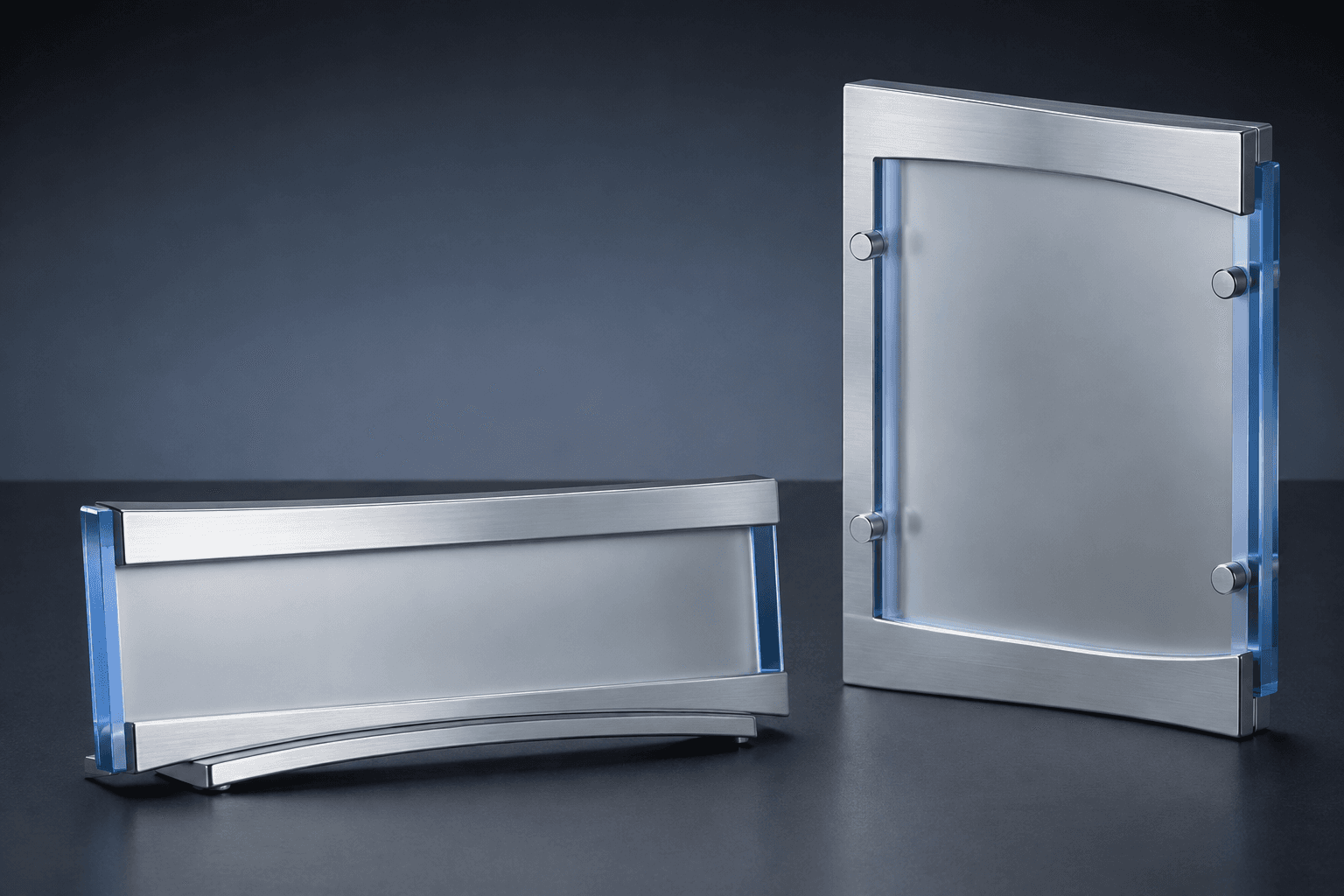
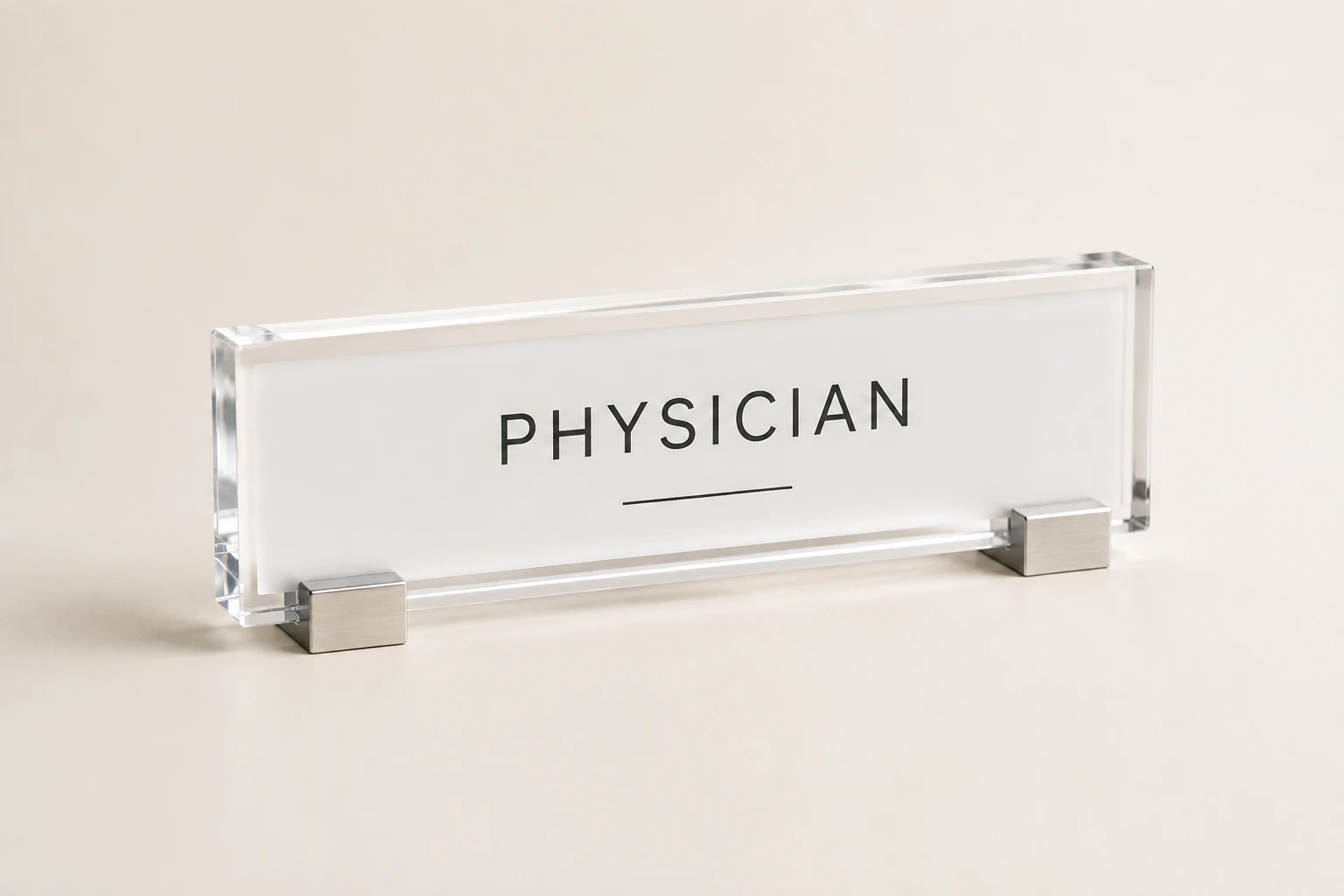
How do you preserve punctuation and credential order intentionally?
Collect the exact visible string, including commas, periods, spaces, accents and any approved ordering of credentials. Do not ask production to normalize every entry to a style inferred from a few examples. If the practice wants a common display convention, its authorized reviewer should define and approve it before the batch is laid out.
When two source records disagree, put the affected text on HOLD and identify the responsible decision maker. A website profile, email signature and old nameplate may reflect different times or purposes. The designer should not choose the version that fits most easily. The approved record must settle the content before layout approval can settle appearance.
Illustrative example: How long is the line Avery Chen, MD?
For a fictional text exercise, use Avery Chen, MD as one line. Avery has five characters, followed by a space, Chen with four, a comma, another space and MD with two. The total is fourteen characters. With a chosen eighteen-character line budget, the text falls within that budget.
The checker does not verify that the fictional person holds a credential or that the practice should use this convention. The worksheet labels the line SAMPLE and gives it an identity reference that could be mapped to two office placements. Both placements should use the same approved text unless the practice explicitly authorizes a variant.
If the practice later approves a changed display string, identify every dependent proof before release. A correction to the identity record should not leave one office with the old version simply because its artwork was prepared earlier. The physical quantity may remain unchanged while the number of proofs requiring review increases.

How do you review long and complex entries before the full batch?
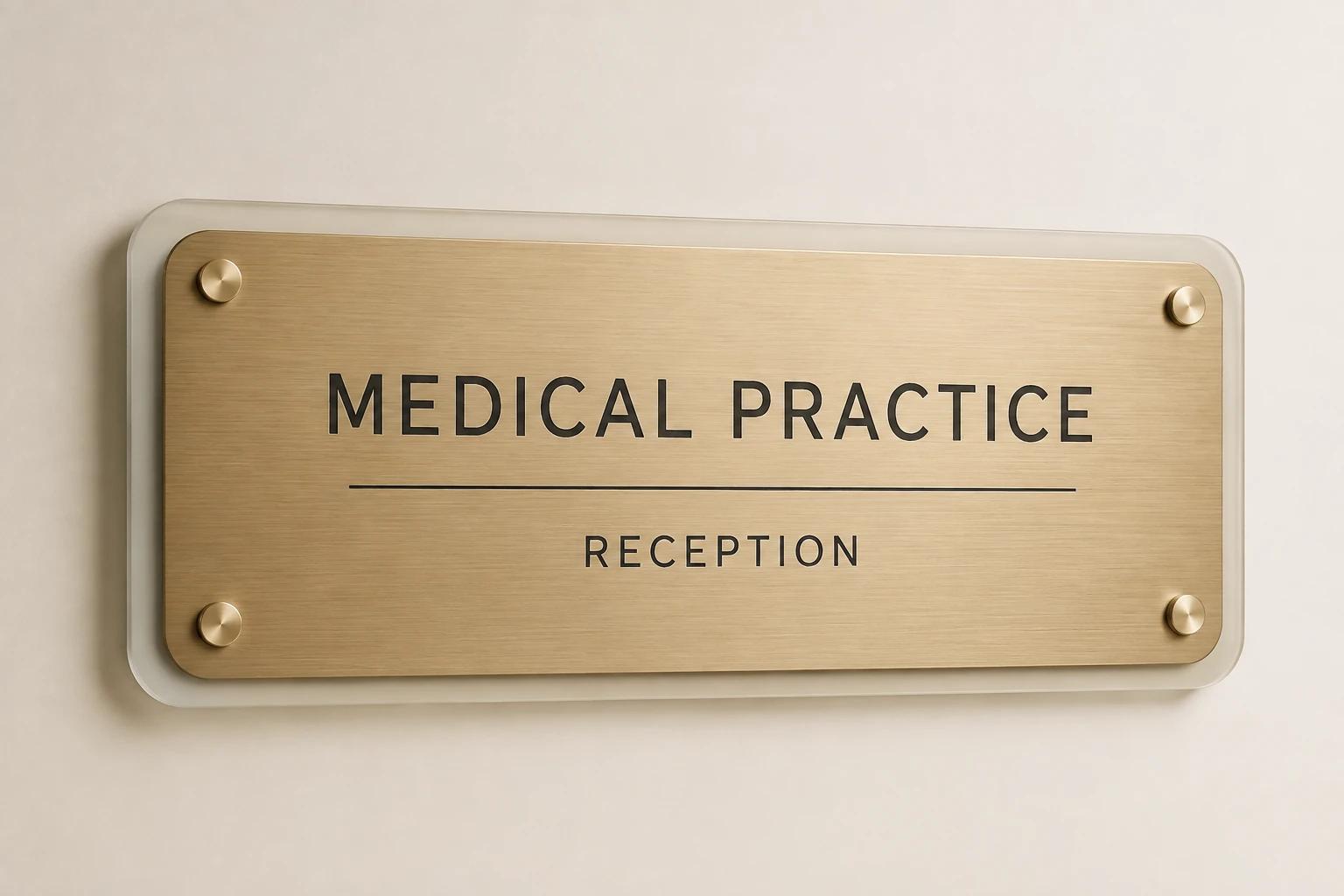
Select representative approved entries that test the proposed layout: a long surname, multiple credentials, an accent or a role line that differs by office. Ask the designer to show those examples in each actual format required. A short desk sample does not establish that a longer corridor insert will work.
Use character counts to identify candidates for review, then inspect the actual-size layout and visible area. Do not shorten a credential or remove punctuation without authorization. If the layout is crowded, compare a revised physical proposal, fewer optional fields or an explicitly approved variant. The practice should decide which information is essential for that sign's purpose.
Check an approved clinician display string
Load the fictional worked example, then replace every assumption with your approved project inputs.
Method: Count entered characters including spaces and punctuation. The tool does not verify credentials, role eligibility or physical fit.
Build your plan
Counts include spaces and punctuation. Character count cannot establish physical fit: font, script, layout, material and engraving area require a proof at actual size.
Use the article’s example files
Fictional example rows show how to separate physical quantities, wording and approval references. Replace them with your project schedule. HOLD and SAMPLE entries are not production instructions.
How do you separate identity approval from facilities approval?
The authorized practice reviewer approves names, credentials and roles. The facilities contact approves the placement and relevant physical requirements through the project's process. A design reviewer can approve visual hierarchy and brand treatment. One sign may need all three decisions, and the release record should show that they address different questions.
If the practice uses one combined approval meeting, record the final identity revision and location schedule revision together. Avoid a general approved message that could refer only to the logo or only to the spelling. The maker needs a concrete set of accepted files and quantities to reproduce.

How do you control corrections across offices?
When a correction arrives, identify the clinician reference, old text, new approved text and affected placements. Mark each proof as needing revision, unchanged or already released, based on the actual production state. Ask the maker about options for released work rather than assuming every file can still be changed.
If an office-specific role differs, preserve that approved difference rather than forcing one universal line. For example, a location might use only the name while another includes an authorized function. Store those as explicit variants connected to the same person. This makes consistency a controlled decision instead of a mechanical copy operation.
How do you check delivery by identity and location?
At receiving, verify the personal text against the approved record and the physical piece against its intended holder or sign format. Then route it to the correct office using the placement reference. Two identical name strings can still require different dimensions at two sites.
Keep the final per-office distribution list with the accepted proofs. If a replacement is requested, the coordinator can identify both the current identity text and the physical specification without searching several unrelated email chains. Remove obsolete working files from active use through the practice's own process so an old credential line is not accidentally revived in the next order.
How do you use a correction matrix for a multi-office batch?
Use a correction matrix with one row per affected clinician and links to every physical placement. Mark each piece as in review, released or received according to its actual state. This shows whether the approved identity update needs artwork revision or a separate remedy for objects that have already been made.
Keep the correction reason narrow. The record can identify an approved display update without including the underlying personnel documents. Ask the responsible practice contact to retain any evidence needed for professional verification in its proper system. The production file should contain the accepted visible statement and its approval reference.
When a clinician has an approved name variant in another script or language, flag that linked version for review too. Do not translate the correction automatically or assume a punctuation change has no effect on the paired layout. Each visible string should remain explicitly approved.
Before release, reconcile the matrix with the actual artwork files. Every affected placement should point to the new selected revision or a clearly explained exception. A batch can contain the correct grand total and still mix old and new credential lines. This matrix gives receiving staff a practical way to check the mixture, rather than asking them to infer current professional wording from whichever proof was printed first.
How do you keep replacements connected to the effective identity record?
A replacement may reproduce an earlier approved inscription or update a clinician’s current role. Ask which purpose applies. Do not assume a historic proof remains current simply because it is the easiest file to find. Identify the intended office and physical format as well.
Record the approved visible name and credentials independently from office placement. If the clinician works at several locations, a text correction can affect multiple pieces while a room move affects only selected placements. This separation helps the coordinator scope the change precisely without circulating appointment schedules or unrelated personnel information.
Which option fits this order?
Use a master identity record for approved personal wording, office records for physical placements and a combined release set for the final mapping. One clinician can require different formats at several sites. Compare those dependencies explicitly so a name correction reaches every affected proof without assuming that identical text means identical hardware.
| Option | Useful when | Scope to resolve |
|---|---|---|
| Master identity record | The same approved name and credentials should be reused consistently. | Authorized current wording, punctuation and any explicitly approved variants. Medical Office Signs lists two-sided hallway flag signs. |
| Office placement record | Each physical piece needs a destination and specification. | Site, room, sign format, holder reference and quantity. |
| Combined release set | The maker needs the final text mapped to the correct physical objects. | Selected proof revisions, unresolved holds and separate identity and facilities approvals. |
Sources: Medical Office Signs: 2 sided wall signs | Health Care Flag Signs
What should buyers confirm before ordering?
Clinician proofreading requires an authorized display record and an office-by-office placement map. A correction can affect several physical pieces with different production states, so cost and timing need a scoped response. These answers separate current professional wording, public references and location variants while keeping unnecessary personnel or patient information outside the production file.
Can a credential correction change the order cost or timing?
Clinic Sign Studio correction requests should identify every affected piece and its actual production state. One approved identity change may require several revised proofs or physical replacements across offices. Ask for a current written remedy before assuming that the same text edit can be applied to all locations within the original cost and delivery arrangement.
Can an online profile verify the engraving text?
Use the practice’s designated approval process. Public profiles can be useful references but may be outdated or written for a different purpose. Ask the designated practice contact to approve the exact visible output and retain professional verification in its proper system. Production needs the accepted name and credential string, not a broad collection of personnel records.
Does a spelling correction change the order quantity?
Usually it changes text rather than quantity, but identify every dependent piece and its production status. A remake or added replacement must be scoped separately. Map the correction to each selected proof and confirm whether it is still in review, released or already received. Those states determine the actual remedy even when the physical count stays unchanged.
Should every office use the same credentials line?
Use the practice-approved convention and any explicit location variants. Do not assume a universal line when the intended sign functions differ. Keep every approved variant connected to the same person reference and its intended use. A designer should not create a shorter credential line simply because one office’s holder has less visible space.
How do two offices share one clinician identity record?
Use one approved display record linked to separate office placements and physical specifications. If the practice authorizes location-specific wording, store those as explicit variants. This keeps a name correction connected across sites without assuming that identical visible text means the pieces share the same dimensions, holders or room assignments.
Sources and scope
The sources below support the cited technical details. The ordering workflows are editorial recommendations. Your project specification, price and schedule are established in the written quote and approved proof.
- Medical Office Signs: 2 sided wall signs | Health Care Flag Signs · checked 2026-09-05
Which buying guide should you read next?
All buying guidesKeep a room’s stable identity separate from changing clinician information so staffing changes do not force unnecessary replacement of the whole sign.
Specify both viewing faces and the complete support assembly for a corridor sign, while keeping location and facility review separate from the arithmetic.