Clinic Sign Studio · specification guide
How to list credentials on doctor and nurse nameplates
Write the name, a comma, then the credentials: "Jane Lee, MD" rather than "Dr. Jane Lee, MD." For nurses, list the highest degree, then the license, then certifications, as in "Maria Cruz, MSN, RN, CCRN." Clinic Sign Studio engraves the exact credentials your practice approves and ships nameplates worldwide.
Reviewed 2026-09-05 · AI-assisted editorial review. General buying guidance; illustrative scenarios are not customer case studies. Images are AI-generated concepts.
Use this page to settle the format before you order. It covers Dr. versus postnominal letters, the nursing order, what to drop when a plate is small, specialty lines, and the formats for dentists, physician assistants and nurse practitioners. We engrave what you approve. We do not verify licenses, so the practice confirms every credential before the proof.
- Pick one: "Dr." before the name or degree letters after it, not both.
- Nurses: degree, license, then certification (MSN, RN, CCRN).
- Small plate: show the highest degree or the license that patients need to see.
- Put a specialty or job title on its own second line.
- Your practice style guide overrides general rules. Keep it consistent on every plate.
Should a doctor nameplate say "Dr." or "MD"?
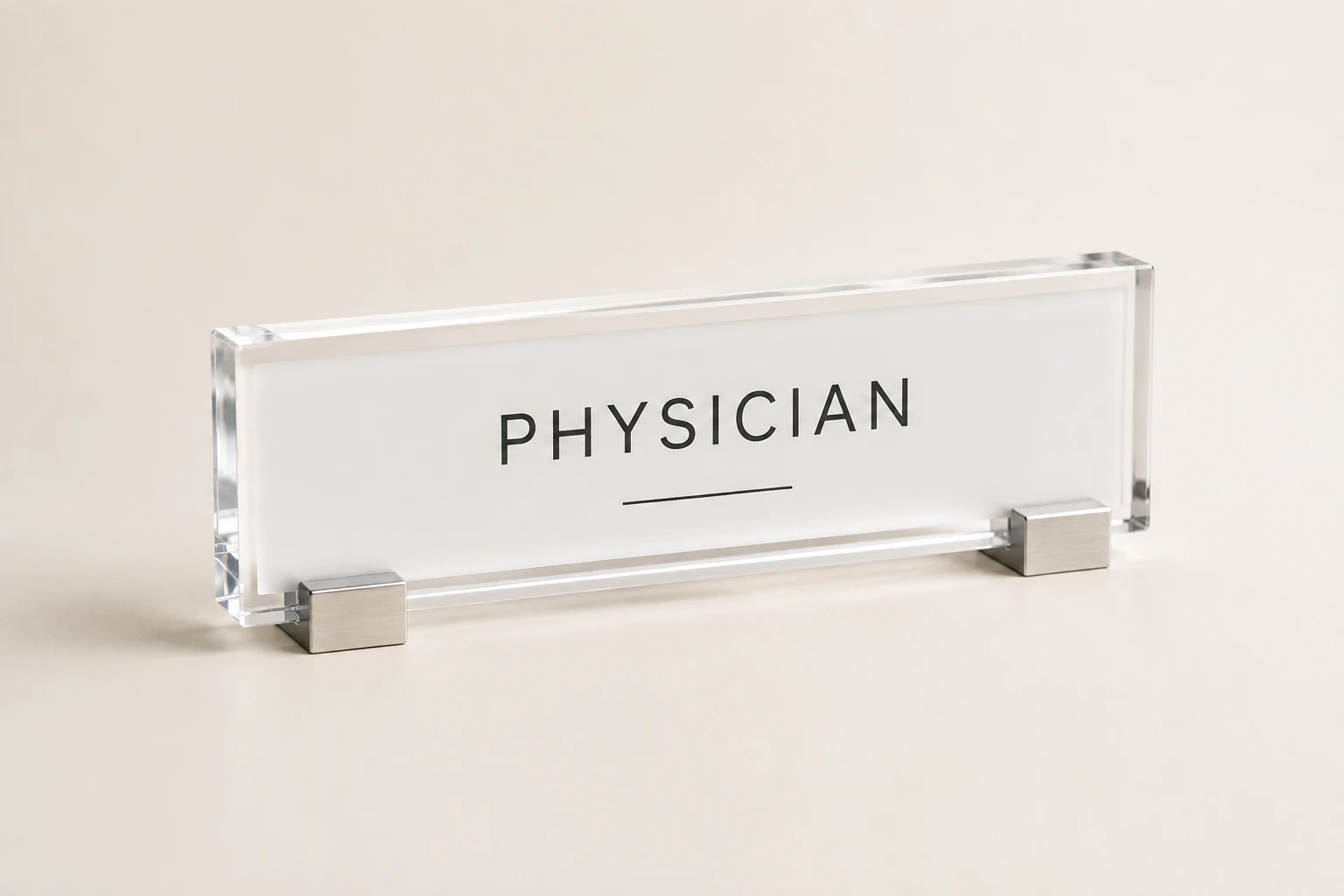
Use either "Dr." before the name or the degree after it, not both. "Dr. Jane Lee" and "Jane Lee, MD" are both correct. "Dr. Jane Lee, MD" says the same thing twice, so most style guides treat it as redundant. On a nameplate, the degree is usually more useful because it tells patients what kind of doctor they are seeing.
This matters most in practices with several kinds of doctors. A PhD psychologist, a DPT physical therapist and an MD can all use "Dr." in speech. On a door or desk plate, "Sam Ortiz, DPT" tells a patient more than "Dr. Sam Ortiz." Some practices still prefer "Dr." on desk plates for a warmer feel. That is a style choice, and it is fine if every plate follows it.
- "Jane Lee, MD" (12 characters): correct
- "Dr. Jane Lee" (12 characters): correct
- "Dr. Jane Lee, MD" (16 characters): avoid: says doctor twice
- "Sam Ortiz, DPT" (14 characters): correct; clearer than "Dr. Sam Ortiz" in a mixed practice
- "Dr. Priya Shah, DO" (18 characters): avoid: pick "Dr." or "DO"
What order do nursing credentials go in?
List the highest earned degree first, then the license, then any state designation, then national certifications. ANCC gives this order: degree, licensure, state designations, national certification, awards and honors, then other recognition. So a nurse with a master's degree, an RN license and critical-care certification is "Maria Cruz, MSN, RN, CCRN."
The reason for the order is simple. Education is permanent, the license is required to practice, and certifications are voluntary and can lapse. Only list the highest degree in a field: "MSN" replaces "BSN," so "BSN, MSN" is not needed. A nurse with a non-nursing master's can show both degrees, with the nursing degree next to the license, as in "Ana Ruiz, MBA, MSN, RN." Awards and honors rarely belong on a door plate.
- "Maria Cruz, MSN, RN, CCRN" (25 characters): degree, license, certification
- "Tom Bell, BSN, RN" (17 characters): correct
- "Tom Bell, RN, BSN" (17 characters): avoid: degree comes first
- "Ana Ruiz, MBA, MSN, RN" (22 characters): two degrees, nursing degree next to license
- "Kim Park, BSN, MSN, RN" (22 characters): avoid: MSN already covers BSN
Sources: American Nurses Credentialing Center (ANCC): How to Display Your Credentials
What should you drop when the nameplate is small?
On a small desk or door plate, keep the name and the one credential patients need, usually the highest clinical degree or the license. A long string of letters at a small size is hard to read from a chair. Drop memberships and most certifications first, then extra degrees, and keep the full list for the website or business card.
A useful test is to ask what a patient should know at a glance. For a physician, that is MD or DO. For a nurse, it is often RN, or the advanced role such as NP. For a nurse educator's office, MSN, RN may be right. Badges often show only the license for the same reason. When two people share a name, keep enough letters to tell them apart.
- Keep: name, highest clinical degree or license, role if patients need it.
- Drop first: society memberships, fellowships, awards.
- Drop next: second degrees and secondary certifications.
- Never drop: anything your practice or employer requires on staff ID.
How do you add a specialty or job title line?
Put the specialty or job title on a second line under the name and credentials, in smaller letters. "Jane Lee, MD" on line one and "Family Medicine" on line two reads faster than one long line. Use the specialty name your practice uses on its website and appointment system, so patients see the same words everywhere.
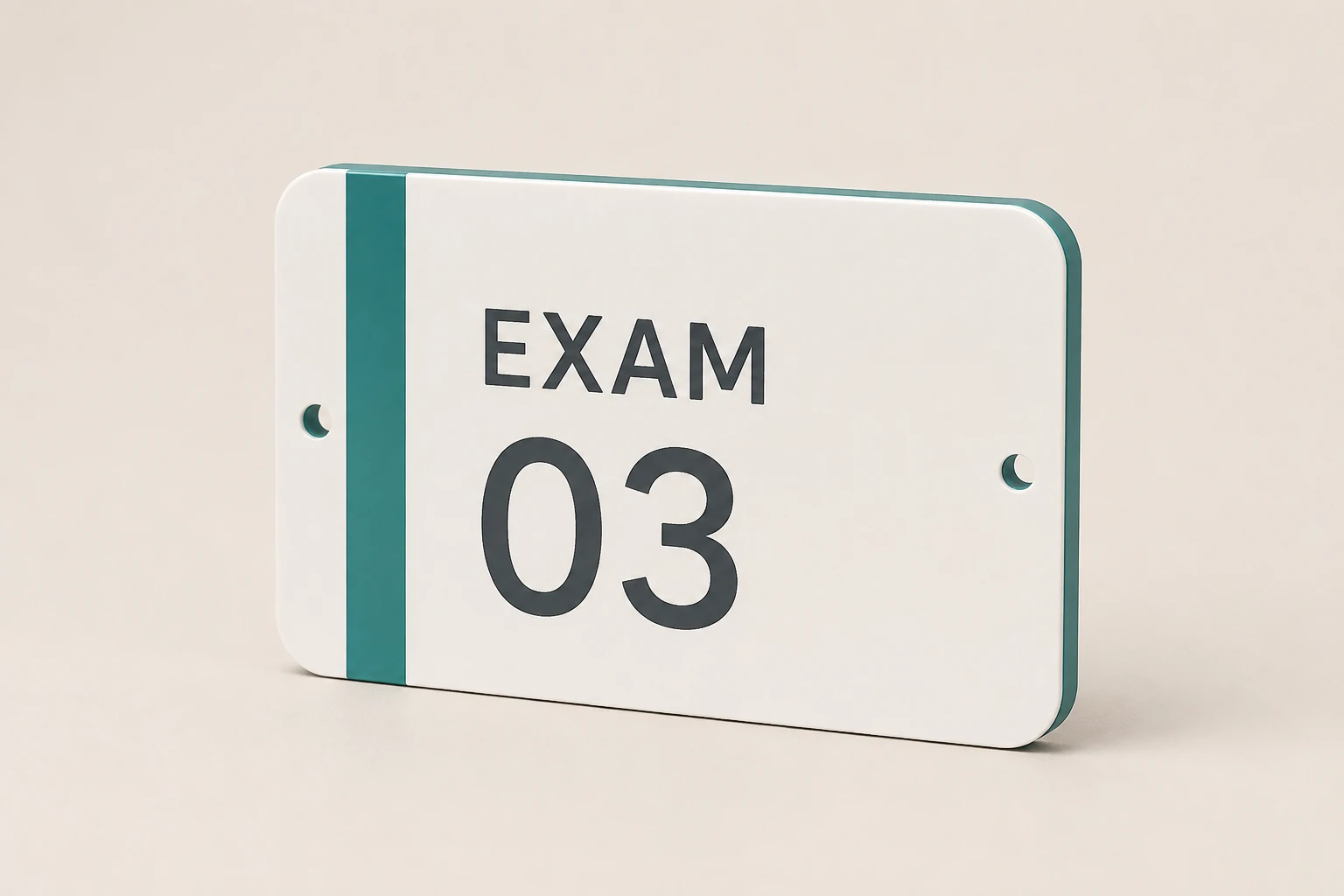
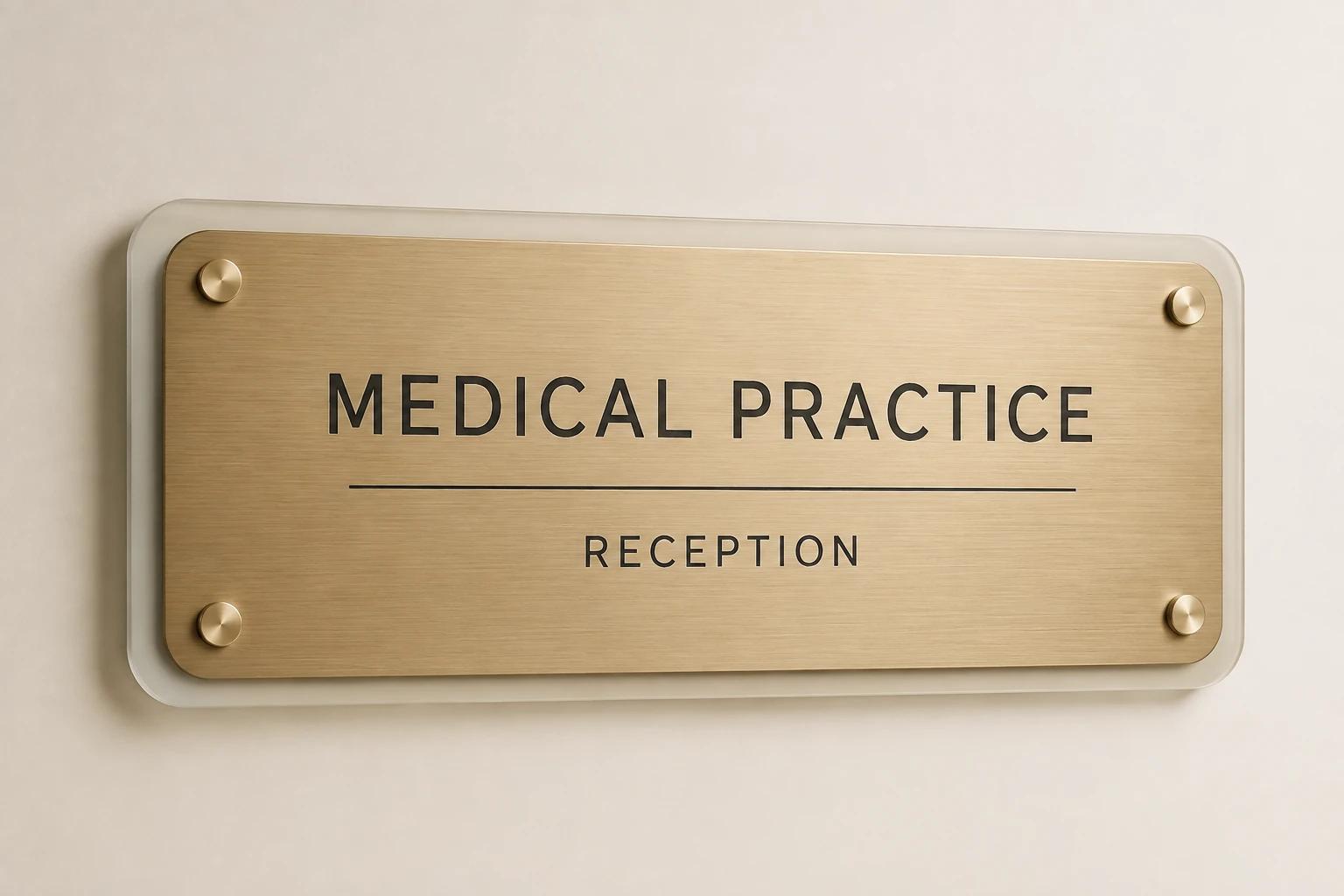
Keep the second line to a few words. "Pediatric Nurse Practitioner" is clear. "Board-Certified Pediatric Nurse Practitioner and Lactation Consultant" will not fit most desk plates. If you need a third line, it is usually the practice name, which the Clinic Nameplate Set can carry as a shared design across desk plates and room signs. Room function, such as "Exam 3," belongs on the Clinic Room & Exam Sign, not the clinician plate.
- "Family Medicine" (15 characters)
- "Pediatric Nurse Practitioner" (28 characters)
- "Practice Manager" (16 characters)
- "Orthopedic Surgery" (18 characters)
Check your nameplate line lengths
The example loads two lines from the illustrative practice. Replace them with your own approved name, credentials and role, then compare counts across the set.
Method: Counts visible characters, spaces and punctuation by line against the characters-per-line budget you enter. It does not establish physical fit or verify any credential.
Build your plan
Counts include spaces and punctuation. Character count cannot establish physical fit: font, script, layout, material and engraving area require a proof at actual size.
How should dentists, PAs and nurse practitioners be listed?
Dentists use DDS or DMD after the name, as in "Ben Cho, DDS." The American Dental Association says the two degrees meet the same education standard and state boards treat them as equal, so use whichever one the dentist actually holds. Physician assistants who are currently certified use PA-C, as in "Lena Ford, PA-C."
NCCPA says the PA-C mark may be used only while certification is current, so confirm it before the proof and again when you reorder. Nurse practitioners usually show the degree, the license and the certification, such as "Joy Kim, MSN, APRN, FNP-BC" or "Joy Kim, DNP, FNP-C." The exact letters depend on the certifying body and state, so copy them from the certificate or license record, not from memory.
- "Ben Cho, DDS" (12 characters)
- "Ben Cho, DMD" (12 characters)
- "Lena Ford, PA-C" (15 characters)
- "Joy Kim, MSN, APRN, FNP-BC" (26 characters)
- "Joy Kim, DNP, FNP-C" (19 characters)
Sources: National Commission on Certification of Physician Assistants (NCCPA): Become Certified; American Dental Association: High School and College Students: dental degrees
Nameplate layout examples by role, with character counts
These layouts are grouped by length so you can pick a format that suits your plate. Each count includes letters, spaces, commas and periods. Short lines suit small desk plates and badge-sized signs. Medium lines suit most desk and door plates. Long lines usually need two lines or a wider plate. Confirm the final fit on your proof.
All names are made up. Swap in the real name and credentials, then paste each line into the Engraving Text Length Checker to see the count for your own text.
- Short (under 15 characters):
- "Ana Ruiz, RN" (12 characters)
- "Ben Cho, DDS" (12 characters)
- "Lee Park, MD" (12 characters)
- "Sam Ortiz, PT" (13 characters)
- "Ava Ng, NP" (10 characters)
- "Eli Moss, DO" (12 characters)
- "Jo Tran, PA-C" (13 characters)
- "Kai Bell, LPN" (13 characters)
- Medium (15 to 23 characters):
- "Jane Lee, MD, FACP" (18 characters)
- "Tom Bell, BSN, RN" (17 characters)
- "Lena Ford, PA-C" (15 characters)
- "Sam Ortiz, PT, DPT" (18 characters)
- "Rosa Diaz, RN, CPN" (18 characters)
- "Dr. Hannah Wells" (16 characters)
- "Omar Aziz, MD, MPH" (18 characters)
- "Grace Lin, DMD, MS" (18 characters)
- "Ian Shaw, MSN, RN" (17 characters)
- "Nina Patel, OTR/L" (17 characters)
- "Carlos Vega, LCSW" (17 characters)
- Long (over 23 characters, plan two lines):
- "Maria Cruz, MSN, RN, CCRN" (25 characters)
- "Joy Kim, MSN, APRN, FNP-BC" (26 characters)
- "Ana Ruiz, MBA, MSN, RN, NEA-BC" (30 characters)
- "Elizabeth Montgomery, MD" (24 characters)
- "Christopher Alvarez, DNP, FNP-C" (31 characters)
- "Rachel Goldberg, PharmD, BCPS" (29 characters)
- Second lines (specialty or role):
- "Internal Medicine" (17 characters)
- "Family Nurse Practitioner" (25 characters)
- "Clinical Nurse Manager" (22 characters)
- "Pediatric Dentistry" (19 characters)
- "Physical Therapy" (16 characters)
- "Behavioral Health" (17 characters)
- "Charge Nurse" (12 characters)
- "Director of Nursing" (19 characters)
- "Women's Health" (14 characters)
- "Sports Medicine" (15 characters)
How do you check that a name and credentials will fit?
Type each line into the Engraving Text Length Checker, set a characters-per-line budget, and see which lines run long. The tool counts letters, spaces and punctuation. It cannot tell you the physical fit, because letter style, size and plate area all matter. Clinic Sign Studio confirms the real fit on a proof at actual size.
We do not publish a maximum character count for any nameplate, because it changes with the font and layout. Use the checker to compare options instead. If "Christopher Alvarez, DNP, FNP-C" is 31 characters and your other plates run about 18, plan two lines or a shorter credential string so the set stays even. Send the final text as typed, with the exact punctuation you want.
Illustrative example: one practice, three nameplate formats
In this made-up example, a family practice orders desk nameplates for a physician, a nurse practitioner and a nurse. The manager wants one consistent style. The team chooses "name, credentials" on line one and role on line two, with no "Dr." anywhere, because the practice also has a DPT and a PharmD on staff.
Line one for each person is "Elena Park, MD" (14 characters), "Joy Kim, MSN, APRN, FNP-BC" (26 characters) and "Tom Bell, BSN, RN" (17 characters). The 26-character string is much longer than the others. The manager asks Joy, who chooses "Joy Kim, APRN, FNP-BC" (21 characters) for the desk plate and keeps the full string for the website. Line two reads "Family Medicine," "Family Nurse Practitioner" and "Registered Nurse." The manager checks each credential against the license and certificate records, then approves the proof.
Which credential format should your nameplate use?
The right format depends on the role and how much room the plate has. This table shows the usual choice, what to avoid, and why. Your practice style guide can choose differently, as long as every plate in the set follows the same rule. Clinic Sign Studio engraves the version you approve.
| Option | Use this | Avoid this | Why |
|---|---|---|---|
| Physician | Jane Lee, MD | Dr. Jane Lee, MD | The title and the degree say the same thing. |
| Registered nurse with a degree | Tom Bell, BSN, RN | Tom Bell, RN, BSN | The degree comes before the license in the ANCC order. |
| Nurse with a master's | Ian Shaw, MSN, RN | Ian Shaw, BSN, MSN, RN | List only the highest degree in the same field. |
| Physician assistant | Lena Ford, PA-C | Lena Ford, PA (if certified) | PA-C shows current NCCPA certification; confirm it is current. |
| Dentist | Ben Cho, DDS or Ben Cho, DMD | Ben Cho, DDS, DMD | The degrees are equivalent; use the one the dentist holds. |
| Small badge-size plate | Maria Cruz, RN | Maria Cruz, MSN, RN, CCRN, CEN | Long strings get too small to read at a glance. |
Doctor and nurse nameplate credential questions
These answers repeat the key rules so each one stands alone. Clinic Sign Studio engraves nameplates for practices worldwide using the names and credentials the practice approves. We do not check licenses or certifications, so please confirm each credential with the clinician and your records before you approve the proof.
How much does a doctor desk nameplate cost and how long does it take?
The Doctor Desk Nameplate is listed at $39 to $89 per nameplate, depending on the material and size you choose. Clinic Sign Studio production takes no more than 7 days after you approve the proof, and shipping time is added on top. Your written quote shows the price, the production start date and the shipping service for your address.
Is it wrong to write "Dr." and "MD" together?
Most style guides call "Dr. Jane Lee, MD" redundant, because both parts say the person is a doctor. Pick one. "Jane Lee, MD" tells patients the type of degree, which helps in practices with several kinds of doctors. "Dr. Jane Lee" is also correct if your practice prefers it. Use the same choice on every plate.
What is the correct order for RN and BSN?
The degree goes first, then the license: "Tom Bell, BSN, RN." ANCC lists the order as highest earned degree, licensure, state designations, national certifications, awards and honors, and other recognition. Certifications such as CCRN come after the license, as in "Maria Cruz, MSN, RN, CCRN." Only list the highest degree in the same field.
Should every certification go on a nameplate?
Usually not. A nameplate should help a patient know who they are seeing, so keep the name and the main clinical credential. Drop memberships, fellowships and secondary certifications first if space is tight. Keep the full list for the website or business card. If your employer requires certain letters on staff ID, follow that rule instead.
Can a nurse practitioner use "Dr."?
A nurse practitioner with a doctoral degree, such as a DNP, has earned a doctorate. Many practices and some states have rules about how titles are used in clinical settings, so follow your practice policy and local rules. On a nameplate, "Joy Kim, DNP, FNP-C" is clear and avoids confusion with physicians. We engrave the format the practice approves.
What do you need from us to make the nameplates?
Send the name and credentials exactly as each should appear, typed, with commas and periods. Add the second line, such as specialty or role, and the practice name if it appears. Tell us the plate style, the quantity, and the arrival date. Clinic Sign Studio sends a proof for you to approve before production starts.
What if a credential changes after we order?
Fixed engraving cannot be edited, so a new credential means a new plate. If your staff change often or are still finishing degrees, ask about a changeable insert style for doors. Our guide on permanent room signs versus changeable clinician inserts compares the two. For one person, reordering a single matching desk plate is usually simplest.
Sources and scope
The sources below support the cited technical details. The ordering workflows are editorial recommendations. Your project specification, price and schedule are established in the written quote and approved proof.
- American Nurses Credentialing Center (ANCC): How to Display Your Credentials · checked 2026-10-03
- National Commission on Certification of Physician Assistants (NCCPA): Become Certified · checked 2026-10-03
- American Dental Association: High School and College Students: dental degrees · checked 2026-10-03
Which buying guide should you read next?
All buying guidesChoose clear acrylic when the wall behind the plaque is intended to remain part of the design; choose frosted or opaque-backed construction when the lettering needs a more controlled background. Clinic Sign Studio worldwide enquiries should identify the proposed wall, surface texture and artwork layers before selecting a reception plaque by its material name alone.
Order clinical identity signs and appreciation gifts as separate uses, with current professional wording for identification and independently approved recognition messages.
Count actual room placements and shared-space signs from a location schedule, rather than treating the clinician roster as a proxy for the building.
Separate clinician identification, room identity and directional signs before calculating the order. Approve credentials and room names through the practice, then record each sign's placement, faces and mounting requirements. A coordinated design still needs a location-specific schedule.